
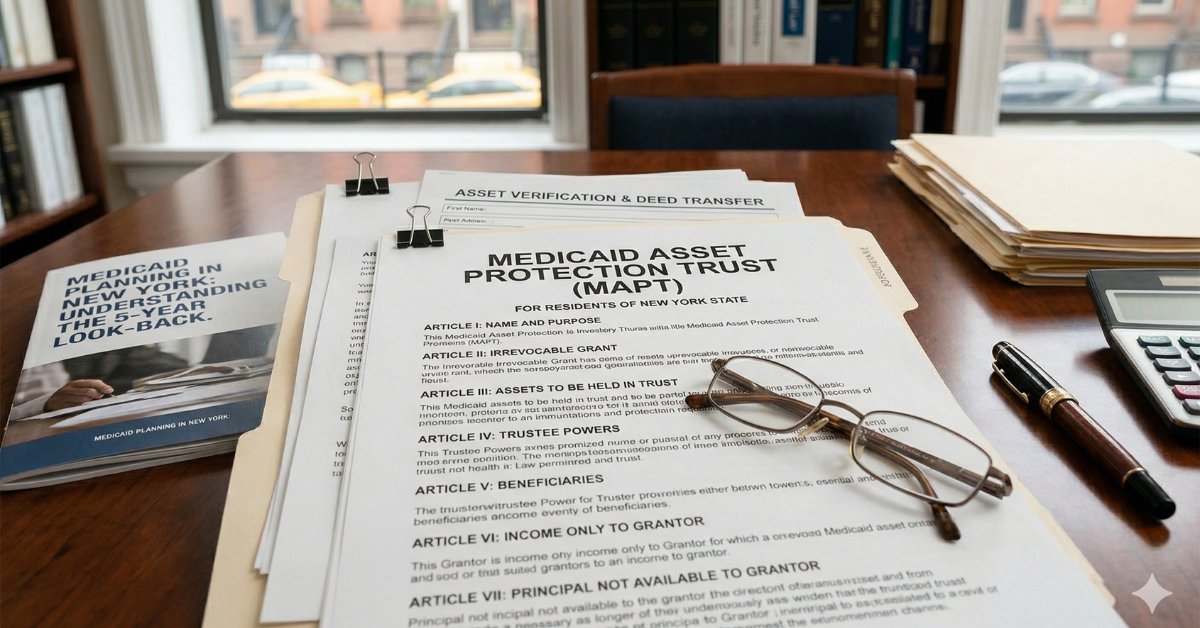
Most people do not think about Medicaid until someone in their family needs a nursing home. At that point the rules feel overwhelming, the costs are already in motion, and the options are narrower than they would have been a few years earlier.
This article explains what a Medicaid Asset Protection Trust (MAPT) is, what it actually does for New York families, and why the timing of when you set one up has a direct effect on how much your family keeps.
Key Takeaways
- Nursing home care in New York is expensive enough to wipe out most families’ savings within a few years, and Medicaid only helps once you have spent down nearly everything you own.
- A Medicaid Asset Protection Trust protects your home and savings from long-term care costs without changing how you live in your home day to day.
- In 2026, New Yorkers who need home care can protect their assets and qualify for benefits almost immediately because a key rule has not yet gone into effect.
- Waiting until a health crisis hits means your family keeps significantly less than if you had planned ahead.
The Cost of Long-Term Care in New York Is Higher Than Most Families Expect
Before getting into what a trust does, it helps to understand the problem it solves.
Medicaid is not regular health insurance. It is a government assistance program for people with limited income and assets. To qualify in New York, you need to spend down most of what you own before Medicaid pays anything toward your care. For a single person in 2026, that means getting countable assets below a threshold set by the state. For most homeowners and retirees, the gap between what they own and what Medicaid allows is significant.
The cost of care makes that gap feel urgent fast. Nursing home care across New York in 2026 ranges from roughly $450 to over $515 per day depending on region, working out to somewhere between $165,000 and $188,000 per year. A family with a few hundred thousand dollars saved could be looking at spending it all within two to three years.
Your home sits in a particularly vulnerable position. While you are alive and living in it, it is generally not counted against you for Medicaid eligibility. But after you pass away, New York State can file a claim against your estate to recover what Medicaid spent on your care. For most New York families, the home is the only meaningful asset left to pass on to their children. Without a plan in place, that claim can take it.
A Medicaid Asset Protection Trust is how families change that outcome.
What a Medicaid Asset Protection Trust Actually Does
A Medicaid Asset Protection Trust is a legal arrangement where you transfer ownership of your assets into a trust. Once inside the trust, those assets belong to the trust, not to you personally. Because you no longer own them directly, Medicaid does not count them when determining whether you qualify for benefits.
That is the core idea. The trust acts as a protective container for what you have built.
You set it up with an attorney, you name a trustee to manage it (most commonly an adult child), and you name the people who will inherit everything when you pass. On paper the trust owns your assets. In practice your daily life stays largely the same.
Here is what you keep after setting up a Medicaid Asset Protection Trust in New York:
- The legal right to live in your home for the rest of your life, written directly into the trust document
- Any income the trust generates, such as interest from savings held inside it
- Your STAR exemption and existing property tax benefits
- The ability to change who inherits from the trust if your family situation changes
What you give up is the ability to directly access the principal inside the trust. You cannot reach in and take out a lump sum whenever you choose. That restriction is not a drawback. It is the mechanism that makes the protection work. Medicaid cannot count assets you have no legal right to access.
Because the home passes to your heirs through the trust rather than through your personal estate, New York’s estate recovery program cannot file a claim against it after you are gone. The house stays in the family.
One thing worth knowing upfront: retirement accounts like IRAs and 401(k)s should not go into a Medicaid Asset Protection Trust. Transferring them triggers a fully taxable distribution, meaning you would owe income tax on the entire balance immediately. New York’s 2026 rules already protect retirement accounts from Medicaid as long as you are taking required minimum distributions, so there is no benefit to moving them into the trust and the tax cost would be severe.
The Two Rules That Govern Timing in New York
Understanding what a Medicaid Asset Protection Trust does is one thing. Knowing when to set it up is where the real planning happens. In New York, two rules shape that timing, and both of them matter in a specific way right now.
- The Five-Year Lookback for Nursing Home Care
When you apply for Medicaid to cover a nursing home stay, the state reviews your financial history going back five years. Any assets transferred during that window, including assets moved into a Medicaid Asset Protection Trust, are treated as a gift. That triggers a penalty period where Medicaid will not pay for your care, even if you otherwise qualify.
The length of that penalty depends on how much was transferred and the nursing home rates in your region at the time of your application. The penalty does not disappear because the money is gone. You are still responsible for covering your own care costs during that window.
The five-year clock starts the day assets are actually moved into the trust. Not the day the trust is signed, but the day it is funded. The sooner that happens, the sooner the protection is complete.
- The Home Care Window That Is Open Right Now
New York passed a law in 2020 to create a 30-month lookback for home care services, meaning people receiving care at home would face the same transfer scrutiny as nursing home applicants. As of January 2026, that rule has still not gone into effect. Federal approval from CMS and state implementation directives still have not been issued, and no start date has been set.
What that means right now: someone can set up a Medicaid Asset Protection Trust today and qualify for home-based care services shortly after, with no penalty period at all. Applications filed before the lookback goes into effect will not be subject to it. That is a meaningful protection for anyone who acts before the rule changes.
There is no confirmed date for when this window closes. But the state has been working toward implementation for years, and the remaining federal approvals are the last steps before it takes effect.
How Fisher Stone Can Help
Medicaid planning in New York involves specific rules, deadlines, and trust drafting that directly shape what your family keeps. The families who protect the most are almost always the ones who planned before they needed to, not because they saw a crisis coming, but because they took the time to have the conversation early.
At Fisher Stone, we work with New York families to protect what they have spent a lifetime building. If you have been thinking about this, reach out to our team to talk through your situation.
Does putting my home in a MAPT mean I lose it?
No. Your right to live in the home for the rest of your life is written directly into the trust document. The trust owns the property on paper, but nothing about your daily life there changes. Your STAR exemption and property tax benefits stay in place as well.
Can an irrevocable trust ever be undone?
Yes, under certain conditions. New York law under EPTL Section 7-1.9 allows an irrevocable trust to be dissolved if the person who created it and all the beneficiaries agree in writing. In most family situations that means you and your adult children can undo the trust together if circumstances change significantly. Irrevocable does not mean permanent under New York law.
Should I put my IRA or 401(k) into a MAPT?
No. Transferring a retirement account into an irrevocable trust triggers a fully taxable distribution, meaning you owe income tax on the entire balance at once. Under current New York rules, retirement accounts are already protected from Medicaid as long as you are taking at least your required minimum distributions. There is no Medicaid benefit that justifies that tax cost.
What if I need to sell my house after putting it in the trust?
The trustee can sell the home and the proceeds stay inside the trust, fully protected. The trust can also use those proceeds to purchase a new home if needed. This is one of the advantages a Medicaid Asset Protection Trust has over simpler options like a life estate deed, where selling the home during your lifetime creates complications for your Medicaid eligibility.
How soon does a MAPT protect my assets for home care in 2026?
Under current 2026 rules in New York, there is no active lookback period for home care services. A trust can be set up and you can qualify for home-based Medicaid services shortly after, with no penalty period. This is expected to change once New York implements the 30-month lookback it passed into law in 2020. Acting now takes advantage of the window while it remains open.